
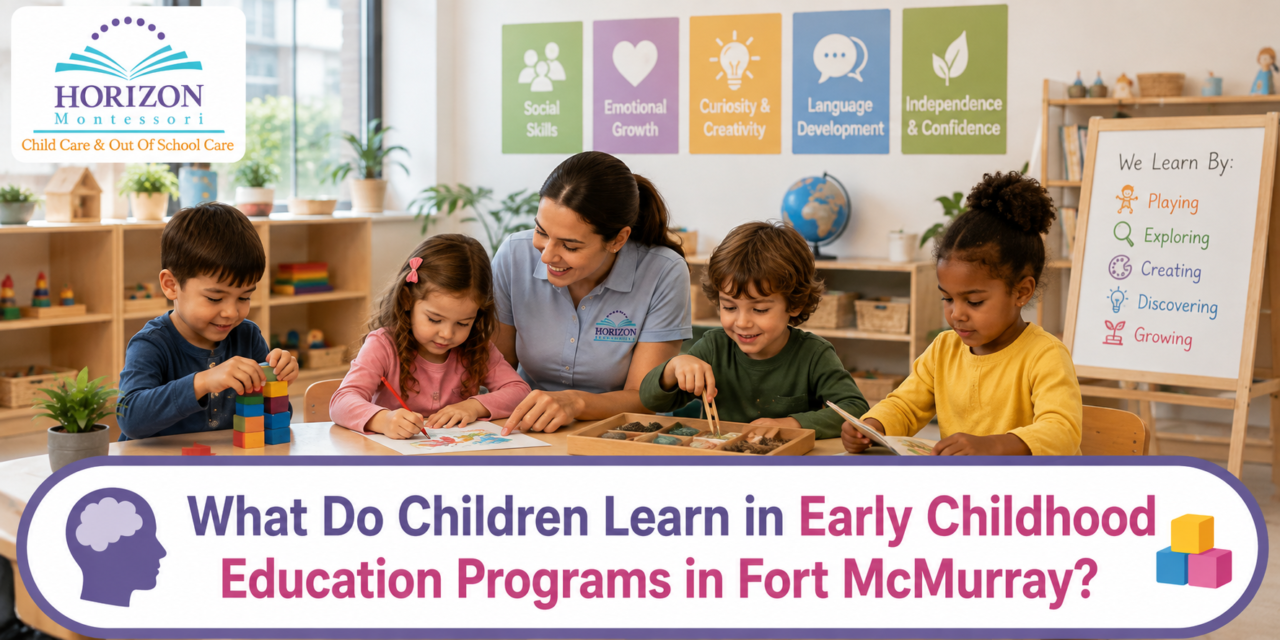
The early years are a period of rapid growth. Children are constantly learning as they play, ask questions, interact with others, explore their surroundings, and try new things.
For parents, this can raise an important question: What do children actually learn in an early childhood education program?
The answer goes far beyond letters and numbers.
High-quality early childhood programs Fort McMurray support the whole child. Children can develop communication, social skills, emotional regulation, physical abilities, early literacy, problem-solving, creativity, independence, and a sense of belonging.
Alberta describes high-quality childcare as an environment that supports children’s social, emotional, physical, and cognitive development. Licensed programs are also expected to provide developmentally appropriate care and learning experiences.
For families considering early learning programs Fort McMurray, understanding these learning areas can make it easier to evaluate childcare options and choose an environment that supports their child’s individual needs.
What Is Early Childhood Education?
Early childhood education refers to learning experiences designed for young children before they enter or progress through formal school.
It combines care, relationships, play, exploration, and intentional learning experiences.
In Alberta, the Flight: Alberta’s Early Learning and Care Framework provides guidance for educators working with children from birth to age six. It takes a holistic, play-based approach to understanding how children learn through play and everyday experiences.
This means children do not need to sit at desks for hours to learn.
A child can learn mathematics while sorting objects. They can develop language while telling a story. They can practice science while exploring water, plants, shadows, or natural materials.
Learning happens throughout the day.
1. Social and Emotional Skills
One of the most important areas of child development Fort McMurray programs support is social and emotional development.
Children learn how to understand themselves and interact with others.
Building Relationships
Children gradually learn how to form relationships with educators and peers.
They practice:
- Greeting others
- Sharing materials
- Taking turns
- Listening
- Cooperating
- Asking for help
- Expressing feelings
- Resolving simple disagreements
These experiences provide a foundation for healthy relationships.
Learning Emotional Regulation
Young children are still developing the ability to manage strong emotions.
Educators can help children identify feelings and learn appropriate ways to respond.
For example, a child may learn to say, “I am frustrated,” instead of immediately reacting physically.
Alberta’s guidance on quality childcare highlights positive child guidance as a way to help children develop healthy self-esteem, respect, executive function, and self-regulation skills.
2. Communication and Language
Language development is another major part of early learning Fort McMurray.
Children learn language by hearing it, using it, experimenting with words, listening to stories, asking questions, and communicating with other people.
Everyday Conversations
Educators can support language development by talking with children throughout the day.
A simple conversation about a child’s drawing can introduce new vocabulary and encourage the child to explain their ideas.
Storytelling and Reading
Books provide opportunities to develop:
- Vocabulary
- Listening skills
- Story comprehension
- Imagination
- Conversation
- Early literacy awareness
Children may also create their own stories through dramatic play, drawings, songs, or conversations.
Expressing Ideas
Children need opportunities to communicate in different ways.
They may use words, gestures, drawings, movement, music, or imaginative play.
Alberta’s early learning framework recognizes communication and literacies as an important area of children’s learning.
3. Early Literacy Skills
Early literacy does not mean forcing preschool children to complete formal reading lessons.
Instead, educators introduce experiences that prepare children for future reading and writing.
What Children May Learn
Children can begin developing:
- Awareness of sounds
- Vocabulary
- Storytelling skills
- Interest in books
- Recognition of symbols
- Understanding that print communicates meaning
- Fine motor control needed for writing
- Confidence in expressing ideas
For example, looking at a picture book and discussing what is happening supports language and comprehension.
Drawing with crayons can strengthen hand and finger control that children later use for writing.
4. Early Math and Problem-Solving
Children also develop mathematical thinking during everyday play.
They do not need worksheets to begin understanding mathematical concepts.
Learning Through Hands-On Activities
Children can explore:
- Counting
- Sorting
- Matching
- Patterns
- Shapes
- Sizes
- Measurement
- Position
- Quantity
A child sorting buttons by colour is already practicing classification.
A child building a tower is exploring balance, size, shapes, and spatial relationships.
Developing Problem-Solving Skills
Educators can encourage children to think rather than immediately provide answers.
Questions such as:
“What could we try next?”
or
“How can we make the tower stronger?”
encourage children to test ideas and learn from the results.
These experiences support early reasoning and problem-solving.
5. Physical Development
Early childhood programs Fort McMurray should also provide opportunities for physical development.
Children develop both large and small muscle skills.
Gross Motor Skills
Gross motor activities involve larger movements.
Examples include:
- Running
- Jumping
- Climbing
- Balancing
- Throwing
- Catching
- Dancing
Outdoor play can provide valuable opportunities for movement and active exploration.
Fine Motor Skills
Fine motor development involves smaller movements.
Children can practice through:
- Drawing
- Cutting
- Building
- Puzzles
- Manipulating small learning materials
- Pouring
- Buttoning
- Using age-appropriate tools
These skills support everyday independence as well as later classroom activities.
6. Creativity and Imagination
Creativity gives children a way to explore ideas and express themselves.
A strong early learning environment does not require every child to create the same finished product.
Instead, educators can provide materials and let children make choices.
Creative Learning May Include
- Art
- Music
- Dance
- Drama
- Storytelling
- Building
- Pretend play
- Open-ended crafts
Imaginative play can also support language and social development.
For example, children pretending to operate a restaurant may practice conversation, counting, cooperation, decision-making, and problem-solving at the same time.
This is one reason play-based learning is valuable.
7. Independence and Life Skills
Young children want to do things for themselves.
Quality early learning programs Fort McMurray can turn everyday routines into learning opportunities.
Children may learn to:
- Put away materials
- Wash their hands
- Organize personal belongings
- Choose activities
- Follow simple routines
- Help with classroom tasks
- Ask for assistance
- Make age-appropriate choices
These tasks may look small to adults, but they help children develop confidence and independence.
Alberta’s quality childcare guidance emphasizes developmentally appropriate experiences and environments that support children’s well-being and development.
8. Science Through Exploration
Young children are naturally curious.
They want to know what happens when they mix, build, pour, move, touch, observe, or change something.
Early childhood educators can turn that curiosity into learning.
Examples of Early Science
Children may explore:
- Plants and nature
- Weather
- Water
- Light and shadows
- Magnets
- Animals
- Materials and textures
- Movement
- Cause and effect
The goal is not to memorize scientific terminology.
The goal is to encourage children to observe, ask questions, make predictions, test ideas, and describe what they notice.
9. Confidence and Self-Expression
Children learn best when they feel safe and valued.
A supportive environment gives children opportunities to express their ideas without fear of being embarrassed for making a mistake.
Educators can encourage children by recognizing effort, listening carefully, asking questions, and giving children appropriate choices.
Why Confidence Matters
A confident child may be more willing to:
- Ask questions
- Try unfamiliar activities
- Speak with others
- Solve problems
- Make choices
- Recover from mistakes
Confidence does not mean children never struggle.
It means they develop the belief that they can try, learn, and improve.
10. Diversity, Inclusion, and Belonging
Children learn about themselves and other people through daily interactions.
Quality childcare should respect children’s different backgrounds, abilities, languages, cultures, and family circumstances.
Alberta’s childcare standards specifically recognize respect for diverse backgrounds, abilities, family circumstances, and cultural and linguistic heritage as part of quality childcare.
Creating a Sense of Belonging
Children should be able to see that their identity and family are respected.
Books, activities, classroom materials, conversations, and celebrations can provide opportunities to learn about similarities and differences.
The goal is to help children develop respect, empathy, curiosity, and a sense of belonging.
How Play Supports Early Learning
Play is not simply a break from learning.
For young children, play is one of the main ways they explore and understand the world.
Alberta’s early learning framework describes play as central to children’s learning and emphasizes holistic, play-based goals.
During one activity, children can develop several skills at once.
For example, building with blocks may involve:
- Counting blocks
- Comparing sizes
- Solving structural problems
- Negotiating with friends
- Developing fine motor skills
- Using language
- Creating imaginary scenarios
This is why high-quality early childhood education Fort McMurray should provide meaningful opportunities for both child-led and educator-supported play.
The Role of Early Childhood Educators
Educators do much more than supervise children.
They observe children’s interests, create learning opportunities, support relationships, ask thoughtful questions, guide behaviour, and communicate with families.
Alberta identifies Early Childhood Educators as central to the early learning and childcare system and recognizes their role in nurturing development, inclusive environments, and relationships with families and communities.
What Good Educators Do
A skilled educator may:
- Observe what a child is interested in.
- Offer materials that extend that interest.
- Ask questions that encourage thinking.
- Support peer interaction.
- Introduce new vocabulary.
- Help children work through challenges.
- Document or communicate learning with families.
This approach makes learning responsive rather than one-size-fits-all.
What Should Parents Look for in an Early Learning Program?
Not every childcare program provides the same experience.
Parents comparing early childhood programs Fort McMurray should look at the complete environment.
Ask About the Learning Approach
Ask:
- Is learning play-based?
- How are children’s interests incorporated?
- What activities are offered?
- How much outdoor play is included?
- How are different developmental needs supported?
Observe Educator-Child Interactions
During a visit, watch how educators speak to children.
Look for respectful communication, patience, encouragement, and genuine engagement.
Review the Program Plan
Alberta requires licensed providers to have a program plan describing their approach to early learning and child development, including daily routines, activities, indoor and outdoor spaces, parent involvement, staffing, and evaluation.
Parents can ask to understand how a centre puts its learning philosophy into practice.
Early Childhood Education in Fort McMurray
Families searching for early childhood education Fort McMurray have different needs.
Some parents want a strong focus on social development. Others may prioritize outdoor play, language development, independence, school readiness, or a particular educational approach.
The right program should recognize that children develop at different rates.
For families in Fort McMurray, Horizon Childcare & Out of School Care can be part of the local childcare search when parents are comparing early learning options.
Parents should contact the centre directly to ask about current programs, age groups, availability, daily routines, enrollment requirements, and the learning experiences offered.
Alberta also provides a childcare search service that allows families to look for licensed childcare by program type and age group.
How Parents Can Support Learning at Home
Early education does not stop when a child leaves the childcare centre.
Parents can reinforce learning through simple everyday experiences.
Talk and Listen
Ask your child about their day and give them time to explain.
Read Together
Read books regularly. Ask questions about characters, pictures, and events.
Encourage Exploration
Let children investigate safe household and outdoor environments.
Let Children Help
Simple tasks such as sorting laundry, preparing food, or putting away toys can support independence and problem-solving.
Follow Their Interests
If your child loves dinosaurs, cars, plants, music, or animals, use that interest to encourage conversation, counting, drawing, reading, and exploration.
Alberta parenting guidance emphasizes that children learn through communication, exploration, interaction, and play, and that adults can support learning by following children’s interests and building on them.
Frequently Asked Questions
What do children learn in early childhood education?
Children in early childhood education develop social, emotional, physical, communication, cognitive, creative, and early academic skills. They learn through play, conversations, relationships, routines, exploration, stories, movement, and hands-on activities. Quality programs focus on the whole child and adapt learning experiences to children’s developmental stages, interests, and abilities.
Why is early learning important for child development?
Early learning is important because young children build foundational skills through everyday interactions and experiences. Quality programs can support communication, self-regulation, relationships, physical development, problem-solving, independence, and early literacy. A nurturing environment also gives children opportunities to explore safely, build confidence, and develop a positive approach to learning.
How does play support early childhood learning?
Play supports early learning because children naturally explore ideas, solve problems, communicate, and practice skills while playing. Building blocks can develop spatial thinking, while pretend play can strengthen language and social skills. Alberta’s early learning framework uses a holistic, play-based approach that recognizes play as central to children’s learning.
When should parents start looking for early learning programs?
Parents should start researching early learning programs before they need care. Starting early gives families time to compare programs, visit centres, understand enrollment requirements, ask about availability, and join a waitlist if necessary. The best timing depends on the child’s age, family schedule, desired start date, and availability in the local area.
Who benefits from early childhood education programs?
Young children can benefit from early childhood education through opportunities for play, relationships, communication, movement, exploration, and independence. Families can also benefit from reliable childcare and strong partnerships with educators. The most appropriate program depends on a child’s developmental stage, individual needs, interests, family circumstances, and the quality of the learning environment.
Conclusion
Early childhood education Fort McMurray is about much more than preparing children to recognize letters and numbers.
Children learn how to communicate. They learn how to cooperate. They develop confidence, independence, physical skills, creativity, early literacy, mathematical thinking, and problem-solving abilities.
Most importantly, they learn through meaningful relationships and experiences.
A quality early learning environment gives children opportunities to ask questions, explore ideas, make choices, solve problems, interact with others, and learn from mistakes. Alberta’s approach emphasizes safe, inclusive, developmentally appropriate, play-based learning that supports the whole child.
For parents researching early learning Fort McMurray, take time to visit programs, speak with educators, review the learning approach, and consider how well the environment matches your child’s needs.
If you are exploring early childhood programs Fort McMurray, contact Horizon Childcare & Out of School Care to learn more about available childcare and early learning options.
Call Horizon Childcare & Out of School Care at +1587-276-0082 today and discuss the right early learning option for your child in Fort McMurray.