
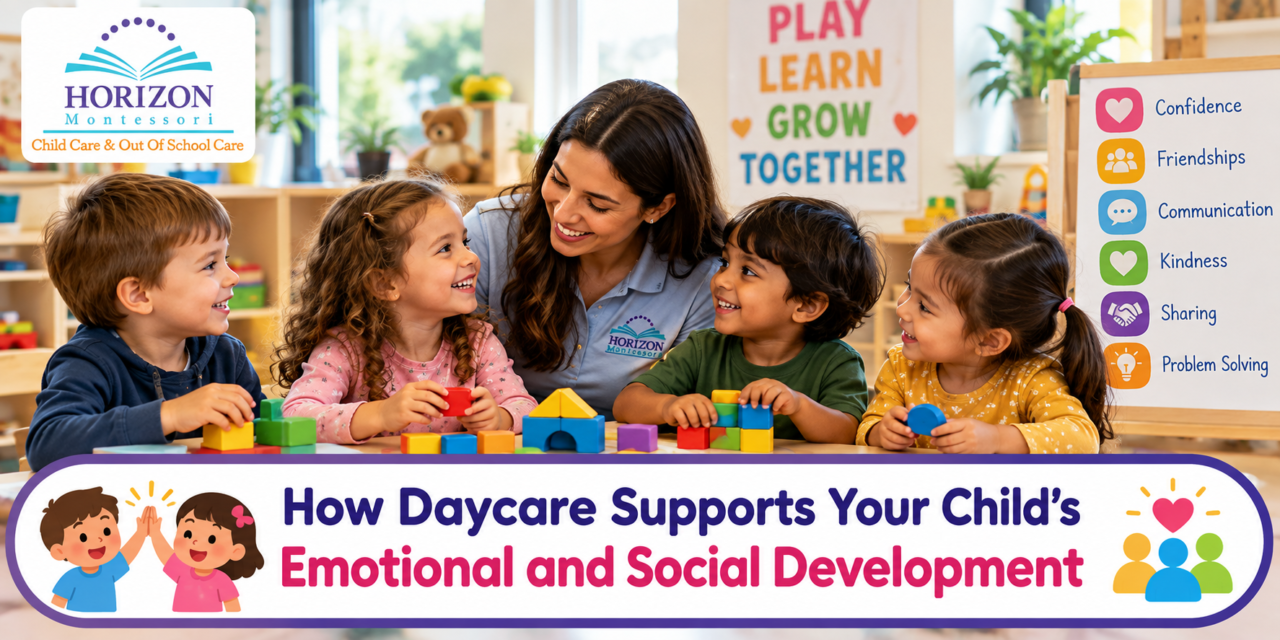
Early childhood is a critical period for developing the skills children use to understand themselves and connect with others. During these years, children learn how to express emotions, communicate needs, form friendships, handle frustration, and respond to different social situations.
For many families, a quality daycare Fort McMurray program provides an important environment where these skills can develop naturally through everyday experiences.
Children do not learn social and emotional skills only through formal lessons. They learn while playing with another child, asking an educator for help, waiting for a turn, cleaning up toys, resolving a disagreement, or comforting a friend.
A well-designed childcare environment gives children repeated opportunities to practice these skills with guidance from caring adults.
Research in early childhood development consistently connects responsive relationships and positive early learning environments with children’s social-emotional development.
What Is Social and Emotional Development?
Social and emotional development refers to how children understand their emotions, manage feelings, build relationships, communicate with others, and respond appropriately to social situations.
These skills include:
- Recognizing and expressing emotions
- Building relationships with adults and children
- Developing self-confidence
- Showing empathy and kindness
- Communicating needs and ideas
- Following simple rules and routines
- Taking turns and sharing
- Managing frustration
- Solving age-appropriate problems
- Becoming more independent
These abilities develop gradually. Children need repeated practice, positive role models, encouragement, and age-appropriate expectations.
A quality child care centre Fort McMurray can provide many of these experiences as part of a child’s normal daily routine.
How Daycare Builds Emotional Development
1. Children Develop Emotional Security
Young children need to feel safe and supported before they can confidently explore their environment.
Consistent educators, predictable routines, and responsive care can help children understand what to expect during the day. When children know that trusted adults are available to help, they can gradually develop a stronger sense of security.
This emotional foundation can make it easier for children to participate in activities, interact with peers, and try new experiences.
2. Children Learn to Recognize Feelings
Children may experience strong emotions before they have the vocabulary to explain them.
Educators can help by naming emotions in simple language. For example, a child who is upset about losing a toy may learn that they are feeling frustrated or disappointed.
Over time, children can become better at identifying what they feel and communicating those emotions appropriately.
This is an important part of emotional literacy.
3. Children Practice Managing Frustration
Young children naturally experience frustration. They may have difficulty waiting, sharing, changing activities, or accepting that they cannot always get what they want.
A supportive daycare environment gives children opportunities to practice coping with these situations.
Educators can model calm responses, acknowledge feelings, and guide children toward appropriate solutions. With repeated practice, children can gradually develop better emotional regulation.
4. Children Build Confidence and Independence
A good early learning environment encourages children to do age-appropriate tasks themselves.
A toddler might put away a toy. A preschooler might choose between two activities. An older child might help prepare materials for a group activity.
Small responsibilities can help children develop confidence because they experience success through their own actions.
This sense of independence is an important part of healthy emotional development.
How Daycare Supports Social Development
1. Children Learn How to Make Friends
Friendships provide children with important opportunities to practice communication and cooperation.
At daycare, children may play together, build with blocks, create artwork, participate in games, or explore outdoor activities.
Through these interactions, they learn how to approach others, communicate ideas, respond to different personalities, and participate in shared activities.
2. Children Learn Cooperation and Sharing
Sharing does not always come naturally to young children. It is a skill that develops through experience and guidance.
Group activities create natural opportunities to practice:
- Taking turns
- Sharing materials
- Listening to others
- Waiting patiently
- Following group instructions
- Helping classmates
These everyday experiences can strengthen children’s ability to participate positively in group settings.
3. Children Develop Communication Skills
Communication involves much more than speaking.
Children also learn to listen, understand facial expressions, recognize body language, and respond appropriately to others.
Educators can encourage children to use words to explain what they want or need rather than relying only on crying, grabbing, or other reactions.
Strong communication skills can support relationships at daycare, school, and home.
4. Children Learn Conflict Resolution
Disagreements are a normal part of childhood.
Two children may want the same toy. One child may not want to follow another child’s game. Another child may become upset during a group activity.
Instead of avoiding every disagreement, educators can use age-appropriate situations to teach children how to resolve problems.
Children can learn to:
- Explain what happened.
- Listen to another person’s perspective.
- Identify how someone feels.
- Suggest possible solutions.
- Choose an appropriate solution.
- Try again.
These early experiences can become building blocks for stronger interpersonal skills later in life.
The Role of Educators in Emotional and Social Growth
Educators play an important role in creating a positive childcare environment.
Children observe how adults communicate, respond to stress, solve problems, and treat others. As a result, educators can become important social and emotional role models.
A responsive educator might get down to a child’s eye level, listen carefully, acknowledge the child’s feelings, and provide simple guidance.
For example, instead of simply saying, “Don’t be upset,” an educator might help a child identify the feeling and discuss what could help.
This approach teaches children that emotions are normal while also showing them that emotions can be managed appropriately.
How Play Supports Social and Emotional Learning
Play is one of the most important ways young children learn.
During pretend play, children can explore different roles and perspectives. During group games, they practice following rules and taking turns. During creative activities, they can express ideas and emotions.
Cooperative Play
Cooperative play requires children to work toward a shared activity or goal.
Children might build a structure together, complete a puzzle, or participate in a group game.
These activities encourage communication, flexibility, teamwork, and patience.
Pretend Play
Pretend play allows children to explore situations they may experience in everyday life.
A child may pretend to be a parent, teacher, doctor, firefighter, or shopkeeper. These roles can encourage imagination while helping children explore different perspectives.
Outdoor Play
Outdoor activities can also support social development.
Children may learn to cooperate during games, navigate physical space, follow safety expectations, and interact with peers in less structured settings.
Why Consistent Routines Matter
Children often feel more comfortable when they understand what happens next.
A predictable daycare routine may include arrival, free play, meals or snacks, learning activities, outdoor time, rest, and departure.
Consistent routines can help children develop:
- A sense of security
- Independence
- Time awareness
- Responsibility
- Self-control
- Adaptability
However, consistency does not mean every moment must be identical. Quality educators can provide structure while remaining responsive to children’s individual needs.
Daycare and Emotional Development for Toddlers
Toddlers are still developing language, self-control, and independence. Their emotions can therefore appear intense and change quickly.
A quality toddler daycare Fort McMurray program should recognize that toddlers need close supervision, responsive communication, safe exploration, and simple routines.
Educators can support toddlers by:
- Naming emotions
- Offering simple choices
- Encouraging communication
- Providing reassurance during transitions
- Modeling gentle behaviour
- Supporting positive peer interactions
- Celebrating small accomplishments
These approaches help toddlers gradually understand that they can communicate their needs and manage everyday challenges.
Preschool and School Readiness
Social and emotional skills also contribute to school readiness.
A child entering kindergarten benefits from being able to listen to instructions, participate in group activities, communicate needs, manage simple frustrations, and interact respectfully with other children.
That is one reason preschool Fort McMurray programs can be valuable for families looking for more than basic supervision.
Early childhood education can combine learning experiences with social opportunities, helping children build skills they can carry into their next educational stage.
The Connection Between Home and Childcare
Children benefit most when caregivers and educators work together.
Parents can share information about a child’s interests, routines, strengths, and challenges. Educators can provide observations about the child’s interactions and progress.
This two-way communication can help adults provide consistent expectations.
For example, if a child is learning to use words when frustrated, parents and educators can use similar language and strategies.
A strong partnership between families and childcare providers can create greater consistency for children.
What to Look for in a Quality Childcare Program
Parents comparing childcare Fort McMurray options should look beyond location and operating hours.
Consider whether the program provides:
Responsive Educators
Look for adults who listen to children, respond respectfully, and understand age-appropriate behaviour.
Positive Peer Interaction
Children should have opportunities to participate in group and individual activities.
Age-Appropriate Activities
Activities should match children’s developmental stages while allowing room for exploration and creativity.
Predictable Routines
Children benefit from a daily structure that balances learning, play, meals, rest, and outdoor activities.
Family Communication
Good communication helps parents understand their child’s experiences and development.
Safe and Welcoming Spaces
The environment should encourage children to explore while providing appropriate supervision and safety.
Local Relevance: Childcare in Fort McMurray
Families in Fort McMurray have different schedules, family structures, and childcare needs. Finding a supportive local program can make daily routines easier while giving children opportunities to learn and build relationships.
A local child care centre Fort McMurray can provide children with consistent social experiences close to their community.
For parents considering early childhood education Fort McMurray, it is helpful to ask how a program supports emotional development, peer interaction, communication, independence, and play.
Horizon Childcare & Out of School Care serves families looking for childcare support in Fort McMurray. The goal of a strong early learning environment is not simply to keep children occupied. It is to create meaningful experiences where children can learn, play, communicate, and develop important life skills.
Frequently Asked Questions
What emotional skills can children develop at daycare?
Daycare can help children develop emotional awareness, confidence, self-regulation, and communication skills. Through daily interactions, children learn to identify feelings, express needs, cope with frustration, and seek help from trusted adults. Consistent routines and supportive educators can also help children feel secure while gradually developing independence.
Why is daycare important for social development?
Daycare gives children regular opportunities to interact with peers outside their immediate family. Group play can teach children how to share, take turns, listen, cooperate, communicate, and solve simple disagreements. These repeated social experiences help children practice relationship skills in a supportive and age-appropriate environment.
How does daycare help toddlers manage emotions?
Toddler daycare can support emotional development by providing predictable routines, responsive educators, and opportunities to communicate feelings. Educators can name emotions, offer simple choices, model calm behaviour, and help toddlers recover from frustration. Over time, these experiences can strengthen emotional regulation and communication skills.
When should parents start looking for childcare?
Parents should begin researching childcare options as early as practical because availability can vary by community and program. Starting early gives families time to compare programs, ask about routines and educational approaches, understand enrollment requirements, and choose an environment that fits their child’s developmental and family needs.
Who benefits from early childhood education?
Young children benefit from early childhood education because it combines age-appropriate learning, play, relationships, and social experiences. Children can develop communication, cooperation, independence, problem-solving, and emotional skills. Families can also benefit from reliable childcare that supports children’s development while fitting into their daily routines.
Conclusion
Emotional and social development begins in everyday moments. A child learns by playing with friends, talking with educators, solving small problems, expressing feelings, and participating in routines.
A quality daycare Fort McMurray program can provide a safe and supportive environment where children practice these skills every day.
For families searching for childcare Fort McMurray, preschool Fort McMurray, toddler daycare Fort McMurray, or early childhood education Fort McMurray, it is important to choose a program that values both learning and emotional well-being.
Horizon Childcare & Out of School Care is committed to supporting children and families in the Fort McMurray community. To learn more about childcare options, programs, and availability, contact Horizon Childcare & Out of School Care at +1587-276-0082.