
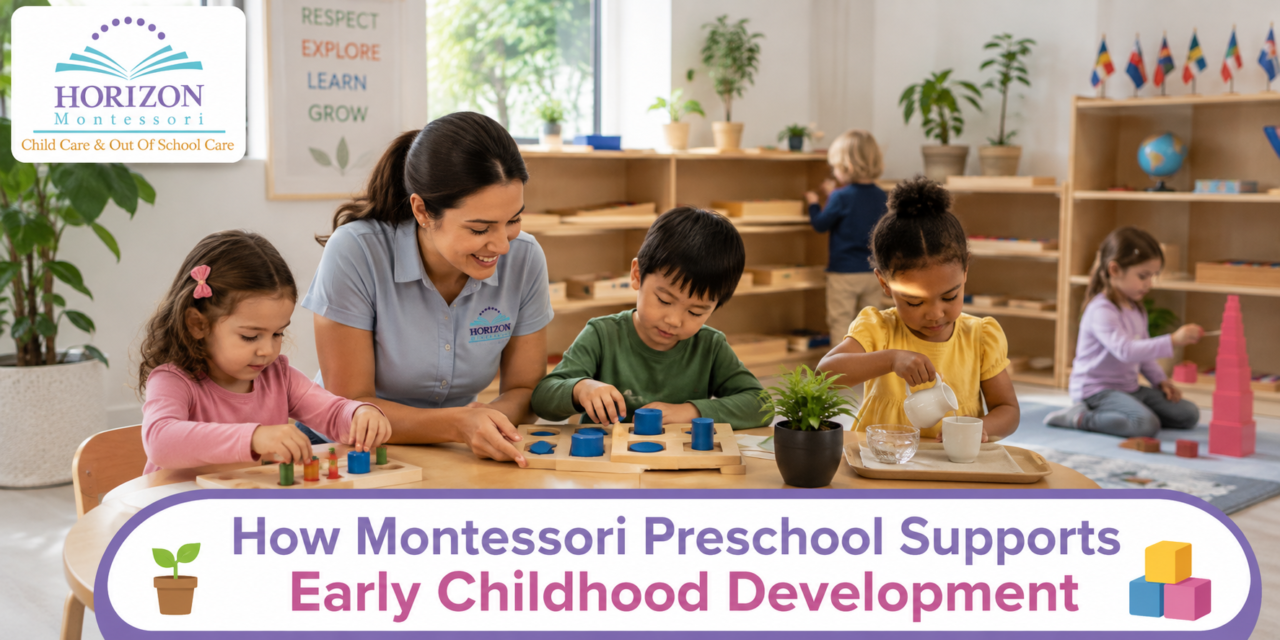
The preschool years are a time of rapid development. Children build language, movement, social, emotional, and thinking skills through everyday experiences.
For parents searching for preschool Fort McMurray, choosing the right educational approach can therefore feel like an important decision. Montessori education offers a distinctive approach that emphasizes independence, hands-on exploration, concentration, and respect for the child’s developing abilities.
A Montessori preschool in Fort McMurray typically provides a prepared environment where children can select appropriate activities, work with specialized materials, and develop skills through repeated practice.
Montessori education is not simply about using wooden learning materials. The approach combines the environment, educator guidance, purposeful activities, independence, and respect for children’s development.
What Is Montessori Preschool?
Montessori preschool is an early education approach based on the educational principles developed by Dr. Maria Montessori.
The classroom is designed to encourage children to become active participants in their own learning.
Instead of an educator directing every activity, children often choose from carefully presented materials and work independently or in small groups.
The educator observes, guides, demonstrates, and introduces activities when a child is ready.
The Prepared Environment
The Montessori classroom is often called a “prepared environment.”
This means the space is intentionally organized around children’s developmental needs.
Materials are generally placed where children can reach them. Furniture is sized appropriately. Activities have a clear purpose and are arranged in an orderly way.
This environment encourages children to make choices while learning how to care for their classroom and materials.
Hands-On Learning
Montessori education places strong emphasis on hands-on experiences.
For example, children may learn mathematical concepts using concrete materials before moving toward more abstract ideas.
They may also practice language, sorting, matching, sequencing, sensory exploration, practical life skills, and fine-motor development.
This approach gives children an opportunity to learn by doing.
How Montessori Supports Early Childhood Development
1. Encourages Independence
One of the most recognizable features of Montessori education is its focus on independence.
Children are encouraged to complete appropriate tasks themselves rather than having an adult do everything for them.
A preschool child might:
- Put materials away after use
- Pour water
- Prepare a simple snack
- Put on a coat
- Choose a classroom activity
- Clean a small spill
- Arrange learning materials
- Help care for classroom plants
These activities may look simple, but they provide valuable opportunities to practice coordination, decision-making, responsibility, and confidence.
A Montessori daycare Fort McMurray program can use similar practical experiences throughout the child’s daily routine.
2. Builds Concentration
Young children need opportunities to focus without constant interruption.
Montessori activities are often designed around a specific task. A child may repeat the activity several times to understand how it works.
Repeated practice can encourage persistence and concentration.
The child learns that completing a task can require patience and effort.
This does not mean children must sit still all day. Montessori classrooms balance focused individual work with movement, social interaction, outdoor experiences, and other age-appropriate activities.
3. Develops Problem-Solving Skills
Montessori materials often allow children to discover relationships and correct mistakes through the activity itself.
For example, a child working with a puzzle or matching material can test different possibilities and adjust their approach.
This creates opportunities for children to ask:
What happened? Why did it not work? What can I try next?
Problem-solving skills are useful beyond preschool. Children use them when building, creating, communicating, playing, and managing everyday challenges.
4. Supports Early Academic Skills
Montessori education can support early literacy and numeracy through concrete, hands-on experiences.
Children may explore:
- Letter sounds
- Vocabulary
- Storytelling
- Writing preparation
- Counting
- Number recognition
- Patterns
- Sorting
- Shapes
- Measurement
- Classification
The objective is not to pressure preschool children into academic work.
Instead, educators introduce concepts through developmentally appropriate materials and activities.
A 2023 systematic review found positive effects of Montessori education on several academic outcomes, including mathematics and language, although the size and quality of evidence differed across outcomes.
Montessori and Social-Emotional Development
Montessori education does not focus only on academic skills.
Children also need to learn how to communicate, cooperate, manage emotions, and participate respectfully in a community.
Grace and Courtesy
Montessori classrooms often place emphasis on “grace and courtesy.”
Children may learn practical social behaviours such as:
- Greeting others
- Waiting for a turn
- Speaking politely
- Walking carefully around others
- Asking before taking an item
- Helping classmates
- Resolving simple disagreements
These skills are practiced during real interactions rather than taught only as rules.
Learning in a Community
A Montessori classroom can include children working independently while sharing the same environment.
This creates natural opportunities to observe others, cooperate, ask questions, and respect different work choices.
Children learn that they are part of a community while also developing their own independence.
Research included in the 2023 systematic review found positive effects for some non-academic outcomes, including social skills, executive function, and creativity, though the certainty of evidence varied.
The Role of the Montessori Educator
A Montessori environment does not replace the teacher.
Instead, the educator has a different role.
The educator carefully observes children, introduces materials, prepares the environment, monitors development, and provides guidance when appropriate.
Observation Is Important
Observation helps educators understand what a child is interested in, what skills they have developed, and where they may need additional support.
For example, if a child repeatedly chooses practical life activities, the educator may introduce more challenging tasks that build coordination and independence.
The goal is to support progress without unnecessarily taking control of the child’s work.
Qualified Early Childhood Educators
Parents should also consider professional qualifications when selecting a Montessori school Fort McMurray.
In Alberta, staff working in licensed daycare, preschool, and out-of-school care programs must meet provincial early childhood educator certification requirements. Alberta has three ECE certification levels, based on education and training.
Families can also use Alberta’s ECE Lookup tool to verify the certification status of certified early childhood educators.
Therefore, parents should ask about both Montessori-specific preparation and Alberta ECE certification.
Montessori Daycare vs. Traditional Preschool
Parents sometimes wonder how Montessori differs from a conventional preschool.
The biggest difference is often the learning approach.
| Montessori Approach | Traditional Preschool Approach |
| Child often chooses from prepared activities | Educator may direct more group activities |
| Strong focus on independence | May place greater emphasis on teacher-led instruction |
| Hands-on learning materials | May use a wider mix of worksheets, toys, and group projects |
| Individual work is common | Group activities may be more frequent |
| Practical life activities are emphasized | Practical skills may receive less classroom focus |
| Educator observes and guides | Educator may lead activities more directly |
Neither approach is automatically right for every child.
The important question is whether the program provides a safe, nurturing, developmentally appropriate environment and whether its teaching approach matches your child’s needs.
Key Montessori Learning Areas
A quality Montessori environment often includes several core areas.
Practical Life
Practical life activities help children develop independence, coordination, order, and responsibility.
Examples include pouring, transferring, cleaning, dressing, food preparation, and classroom care.
Sensorial Learning
Sensorial materials allow children to explore qualities such as size, shape, colour, texture, sound, and weight.
These activities help children refine their senses and classification skills.
Language
Language activities can support vocabulary, phonological awareness, letter recognition, storytelling, writing preparation, and early reading.
Mathematics
Children can explore quantities, numbers, patterns, sequencing, counting, and other early mathematical concepts through concrete materials.
Culture and Exploration
Children may explore nature, geography, science, art, music, and cultural topics.
These experiences encourage curiosity about the world.
Benefits of Montessori for Different Types of Learners
Every child is different.
Some children enjoy choosing their own activities and working independently. Others may need more encouragement and guidance before they become comfortable with independent work.
Montessori can be particularly appealing to families who want their child to develop:
- Independence
- Concentration
- Self-confidence
- Practical skills
- Problem-solving abilities
- Curiosity
- Responsibility
- Respect for others
- A positive attitude toward learning
However, parents should avoid assuming that every Montessori program is identical.
The quality of implementation matters.
A 2023 systematic review found that outcomes varied across studies and settings. This means parents should evaluate the actual program rather than relying only on the Montessori label.
How to Choose a Montessori Preschool in Fort McMurray
Choosing a preschool is an important family decision.
If you are researching Montessori preschool in Fort McMurray, visit the centre and ask practical questions.
Ask About the Classroom
Find out:
- What Montessori materials are available?
- How are activities introduced?
- How much choice do children have?
- How is independent work balanced with group activities?
- Is outdoor play included?
- How are transitions handled?
Ask About Educators
Ask about:
- Alberta ECE certification
- Montessori training
- Experience with preschool children
- Professional development
- Staff turnover
- How educators communicate with families
Observe the Environment
During a visit, look at how adults and children interact.
Do educators speak respectfully?
Do children appear engaged?
Is the classroom organized?
Are materials accessible?
Does the environment feel calm, safe, and welcoming?
These observations can be more informative than promotional descriptions alone.
Montessori Preschool in Fort McMurray: Local Considerations
Families searching for Montessori education Fort McMurray should consider both educational philosophy and practical needs.
Location can affect daily drop-offs and pickups. Hours should match the family’s work and transportation schedule. Parents should also understand enrollment requirements, fees, meals or snacks, outdoor activities, communication procedures, and holiday closures.
For families comparing Montessori daycare Fort McMurray options, it is helpful to make a short list and visit each program.
Fort McMurray families may have varied work schedules and commuting needs. A convenient location can make a significant difference to the family’s daily routine.
However, convenience should not be the only deciding factor.
The ideal early learning Fort McMurray environment should combine safety, qualified educators, meaningful learning experiences, responsive relationships, and a developmentally appropriate approach.
Is Montessori Right for Every Child?
Montessori can be a strong option for many children, but no educational approach works identically for every child.
Some children thrive with independent choices and long periods of focused work. Others may prefer more frequent adult direction or highly structured group activities.
Parents should consider their child’s:
- Personality
- Interests
- Developmental stage
- Social comfort
- Learning preferences
- Need for independence
- Response to routines
It is also important to evaluate the specific program.
A school may use the word “Montessori” while implementing the philosophy differently from another program.
The best choice is the environment where your child feels safe, respected, engaged, and supported.
Frequently Asked Questions
What is a Montessori preschool?
A Montessori preschool is an early learning environment based on Montessori principles such as hands-on learning, independence, purposeful activity, and a prepared classroom. Children typically work with developmentally appropriate materials while educators observe, guide, and introduce lessons. The approach supports academic, social, emotional, practical, and problem-solving skills.
Why is Montessori education beneficial for preschool children?
Montessori education can benefit preschool children by providing hands-on activities that encourage independence, concentration, problem-solving, and early academic development. Children also practice communication, cooperation, responsibility, and practical life skills. Research suggests Montessori education can positively affect both academic and non-academic outcomes, although results vary by setting and implementation quality.
How does Montessori support early childhood development?
Montessori supports development through a prepared environment, purposeful hands-on activities, individual choice, repetition, and educator guidance. Practical life activities build independence, sensorial materials develop observation skills, and language and mathematics materials support early academic concepts. Children also develop social and emotional skills through everyday classroom interactions.
When should parents consider Montessori preschool?
Parents can consider Montessori preschool when they want an early learning environment that emphasizes independence, hands-on exploration, concentration, and practical skills. The child’s age, developmental needs, personality, and family schedule should also be considered. Visiting programs and observing classroom practices can help determine whether a particular Montessori environment is suitable.
Who should choose a Montessori school in Fort McMurray?
A Montessori school in Fort McMurray may suit families who value hands-on learning, independence, purposeful activities, and a carefully prepared classroom environment. However, parents should evaluate the specific program, educator qualifications, safety practices, schedule, classroom atmosphere, and implementation of Montessori principles before making a decision.
Conclusion
The preschool years provide children with countless opportunities to build skills that influence how they approach learning and everyday life.
A Montessori preschool in Fort McMurray can support this development through hands-on learning, practical life activities, independence, concentration, social interaction, and carefully prepared environments.
Research suggests Montessori education can have positive effects across academic and non-academic outcomes, but program quality and implementation remain important.
For parents comparing Montessori school Fort McMurray options, look beyond the name. Visit the classroom, meet the educators, ask about qualifications, observe how children are treated, and make sure the program fits your family’s needs.
Horizon Childcare & Out of School Care provides families in Fort McMurray with early learning and child care options designed to support children’s development in a welcoming environment.
To learn more about Montessori-inspired early learning and available child care options, contact Horizon Childcare & Out of School Care at +1587-276-0082 today.