
Choosing the right childcare option is probably one of the more important decisions an average parent will make concerning the early years of their child. While standard daycares give a lot of importance to basic care and group activities in strictly structured environments, a Montessori daycare follows a wider approach, combining a nurturing atmosphere with highly individualized, education-rich environments.
The guide will walk you through how a typical day in the life of a child in a Montessori school daycare would unfold. Once they understand the Montessori method and the routine, they can see how very much it promotes independence, being inquisitive, and wanting to learn forever.
Horizon Montessori Childcare provides child-centered care set in a highly interactive manner. Whether searching for a Montessori School Daycare, montessori childcare centre, or montessori daycare, our goal is to empower every child to succeed.
1. Understanding the Montessori Philosophy
Founded by Dr. Maria Montessori in the early 20th century, the method is based on the philosophy that children learn best when free to explore, make choices, and do things at their own pace in a prepared environment.
In a Montessori environment:
- A teacher has another title of a guide since the teacher guides learning rather than imparting information.
- Children are presented with purposely prepared learning materials to induce self-initiated activity.
- In multiage classrooms, younger children learn from peers, and the older children have an opportunity to practice leadership skills.
This approach views children as essentially curious and competent and gives them many opportunities for the development of independence from a very early age.
2. The Warm Welcome – Morning Drop-Off
At Montessori School Daycare, the day begins with a quiet and welcoming atmosphere. Greeting teachers welcome the children individually to create an environment for them to feel comfortable about starting their day. The parents are, in fact, encouraged to inform the caregivers about their child’s disposition, sleep, or anyone to get proper accommodation.
This period also gives the children an opportunity to suavely drift into their day, rather than promptly starting activities without a transition period. Depending on their choices and preferences, some of the children would spend some moments with their favorite materials and greeting some friends before work cycles kick off.
3. The Morning Work Cycle – Independent Exploration
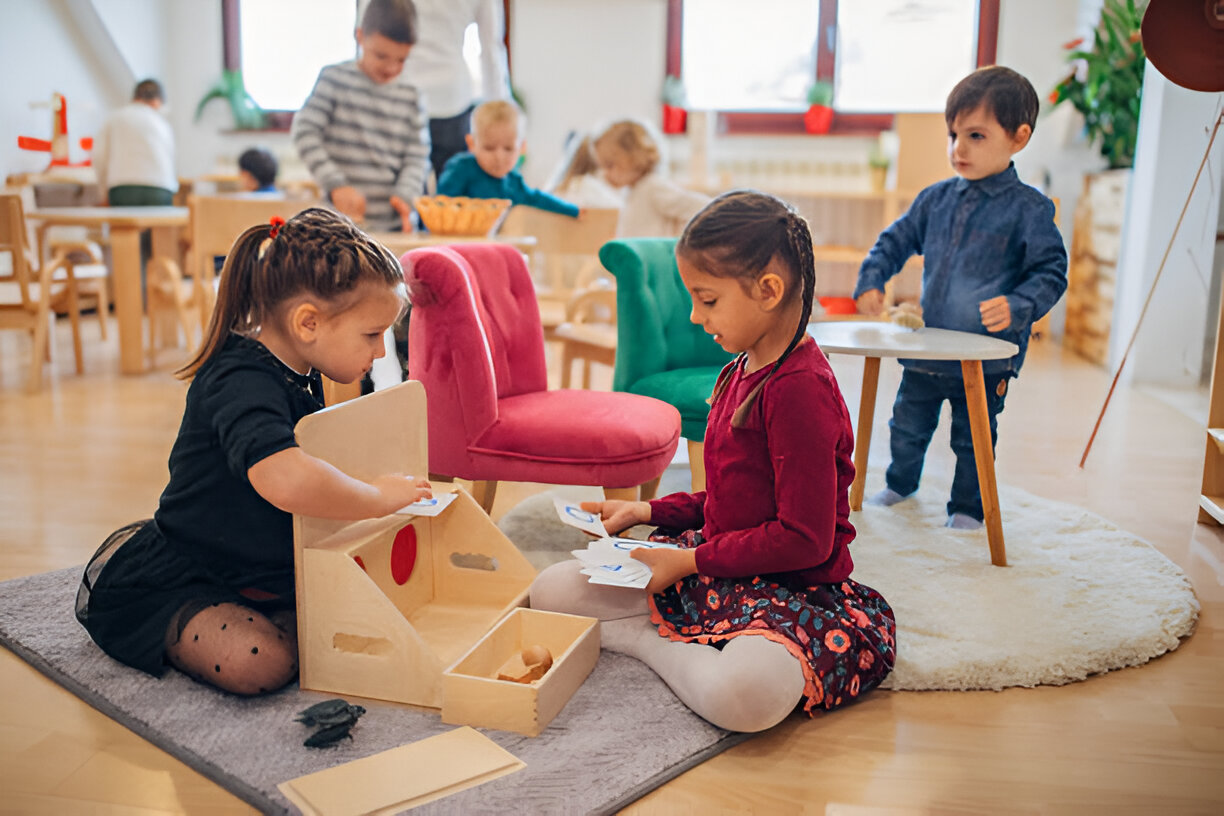
An uninterrupted work cycle is one of the hallmarks of Montessori education; traditionally, it lasts from two to three hours in the morning.
During this time, children:
- Pick activities that suit their interests.
- Work on a task individually or in small groups.
- Involve themselves in hands-on activities, using language, math, sensory development, or practical life materials.
Examples of such activities include:
- Pouring Water from one container to the other to develop fine motor skills.
- Sorting and matching objects by courses and stimuli of color, shape, or size.
- Using sandpaper letters to learn letter sounds and writing.
- Working in math concepts with counting beads or number rods.
Guides move around the room, interfering gently, when necessary, to either support the child or to move a child from an activity to something a bit more difficult or remove materials when the child is ready for something new.
4. Snack Time – Independence in Action
Snack time is learning time at a Montessori daycare. Instead of having snacks presented to them, children are often encouraged to prepare their snacks: washing fruit, pouring milk, or spreading butter on crackers.
This develops:
- Independence.
- Responsibility.
- Fine motor coordination.
Children also practice grace and courtesy- waiting their turns, saying “please” and “thank you,” and cleaning up after themselves.
5. Outdoor Play – Physical Development and Social Skills
Having good weather to get out was necessary for good physical health, whereas sensory activities and socializing were additional bonuses of a good day. A Montessori park has play equipment for the child to witness the great beyond, gardens full of wonder, and landscapes to explore nature.
In turn, this time for outdoor play permits children to:
- Develop their gross motor skills by climbing, running, and balancing.
- Coordinate understand teamwork and cooperation during group games.
- Engage a bond with nature through gardening activities or observing animals.
6. Group Circle Time – Building Community
While much of Montessori learning is self-directed, group activities are also part of the day. Circle time might include:
- Storytelling or reading aloud.
- Singing songs and rhymes.
- A door-to-door chat about the day’s theme, the weather, or cultural festivity.
This aspect works on listening skills, taking turns, and mannerliness in a community setting.
7. Lunch – Learning Through Daily Routines
Between lunch hours, a Montessori Daycare presents another occasion for asserting the independence and social development of the child. Children may help set the table, serve themselves, and clean up after themselves.
The conversations that highlight mealtime later aloud language development, while table manners and the healthy mode for eating are all reinforced in bare act.
8. Rest Time – Recharging for the Afternoon
Rest is crucial even in a busy day of exploration and activity. While younger children can take an afternoon nap, older children get quiet time to either curl up with a good book or get in some gentle exercise.
This time-out is meant to allow children to process their morning learning and also replenish energy for the afternoon session.
9. Afternoon Activities – Creativity and Enrichment
In the afternoons, kids keep doing whatever they were doing in the morning or are given specific enrichment activities that involve:
- An interpretation of their art projects (painting; clay modeling; collage work).
- Music and movement.
- Science experiments.
- Cultural Studies and Geography.
Activities which encourage creativity and problem-solving, along with cultural awareness.
10. Practical Life Skills – Preparing for the Real World
Practical life activities form the perfect complement to the core Montessori curriculum and are thus sprinkled throughout the day. These may include:
- Watering flowers or feeding animals.
- Folding clothes.
- Wiping or sweeping of tables.
- Any manipulation related to self-care: washing hands, brushing teeth, etc.
Working on these skills is so important for helping the child feel self-assured, responsible, and aware of social contributions.
11. End-of-Day Reflection – A Gentle Transition Home
Once the day winds down, all the kids carefully finish their projects and put away materials while reflecting on what they have learned. Parents might be updated about what the children have been doing throughout the day, and properly noteworthy events.
This closing ritual serves as a lull-bye for children back into home life.
12. Why Parents Choose Horizon Montessori Childcare
Much more than a daycare, Horizon Montessori Childcare is a nurturing and educational environment that embraces the individuality of each child. Our programs aim to:
- Promote independence and self-confidence.
- Fall under curiosity and problem solving.
- To be helpful for those developing emotionally, socially, and academically.
From a Montessori Daycare to a Montessori Childcare Center, we offer a setting that nurtures both the academic and social growth of your child.
13. The Lasting Impact of Montessori Education
Children who attend Montessori programs often develop:
- Strong academic foundation.
- Can think of excellent solutions.
- Can be independent; self-disciplined.
- Respecting oneself, others, and their environment.
They are prepared by these qualities for both school and life beyond the classroom.
14. Is Montessori School Daycare Right for Your Child?
If it is an approach that respects the uniqueness of your child, encourages the development of independence, and nurtures academic as well as pertinent life skills, then Montessori daycare would be a good choice for your child. Being an amalgamation of care and education, the affairs of the misconduct mix to give the little ones a balanced and enriching environment.
Final Thought:
A Montessori School Daycare does a lot more than just provide care for your child-it is actually a nurturing environment where the child can develop independence, curiosity, and love for learning on a daily basis. In accordance with all Montana standards and methodologies, Horizon Childcare ensures that the child comes first and that he or she thrives academically, socially, and emotionally, from their very first day.
Horizon Montessori Childcare welcomes families who want more than just childcare—we offer a foundation for lifelong learning.
Call Us Today: +1 587 276 0082 to learn more about our programs and schedule a visit.